
After crossing one of the highest and most demanding sections of the Andes, few experiences feel as rewarding as stepping into warm thermal water surrounded by tropical vegetation. The Salkantay hot springs, better known as the Cocalmayo Hot Springs, are near Santa Teresa and have become one of the most memorable optional stops on the route to Machu Picchu.
The contrast makes the experience special. The Salkantay route begins among glacial landscapes, cold nights, and high-altitude trails, then descends into a humid cloud forest filled with rivers, coffee plantations, and warmer air. By the time trekkers reach Santa Teresa, the Salkantay hot springs offer a natural pause before the final journey toward Hidroelectrica, Aguas Calientes, and Machu Picchu. Climb Sunday’s five-day route follows this geographical transition and reaches Santa Teresa on the third day.
This guide explains where the pools are, how they fit into the trek, what to expect, when to visit, what to bring, and how to choose a Salkantay tour that gives you enough time to enjoy them without rushing.
You might also be interested in: Raymi Llaqta in Chachapoyas: The people’s festival of northern Peru
What Are the Salkantay Hot Springs?
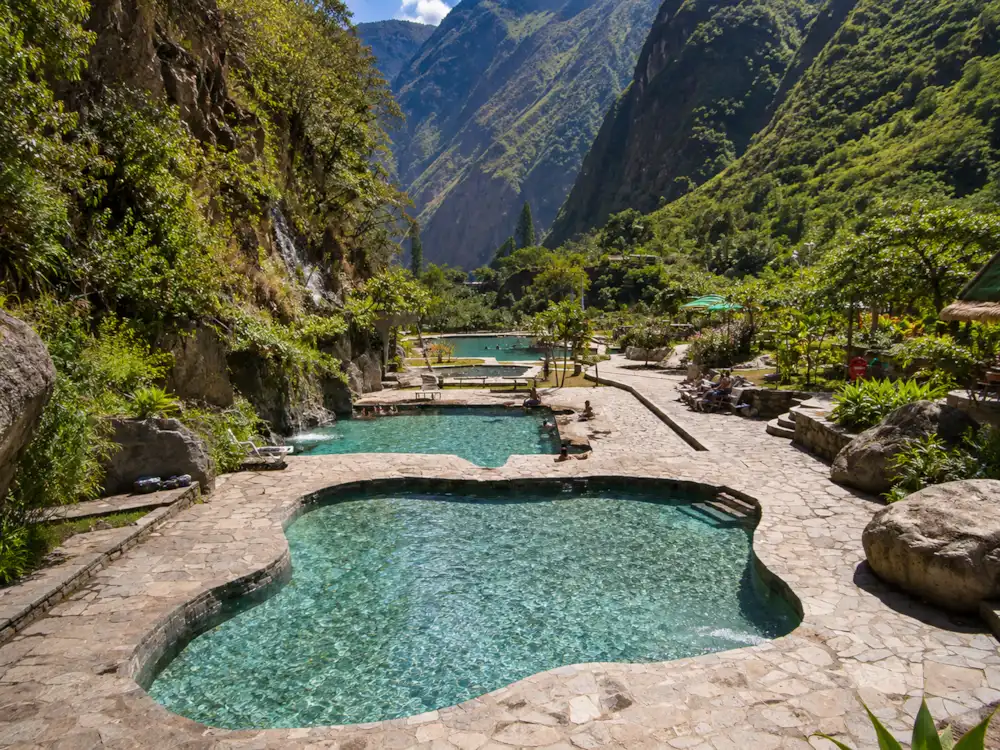
The name Salkantay hot springs usually refers to the Cocalmayo thermal baths in Santa Teresa, La Convención Province, Cusco. The complex sits in a green valley near the Urubamba River at roughly 1,600 meters above sea level, far below the cold conditions experienced at the Salkantay Pass.
Cocalmayo has several outdoor pools that vary in size, depth, and temperature. The source water is commonly reported at approximately 38°C to 44°C, although the temperature felt inside each pool may change according to water flow, weather, and time of day.
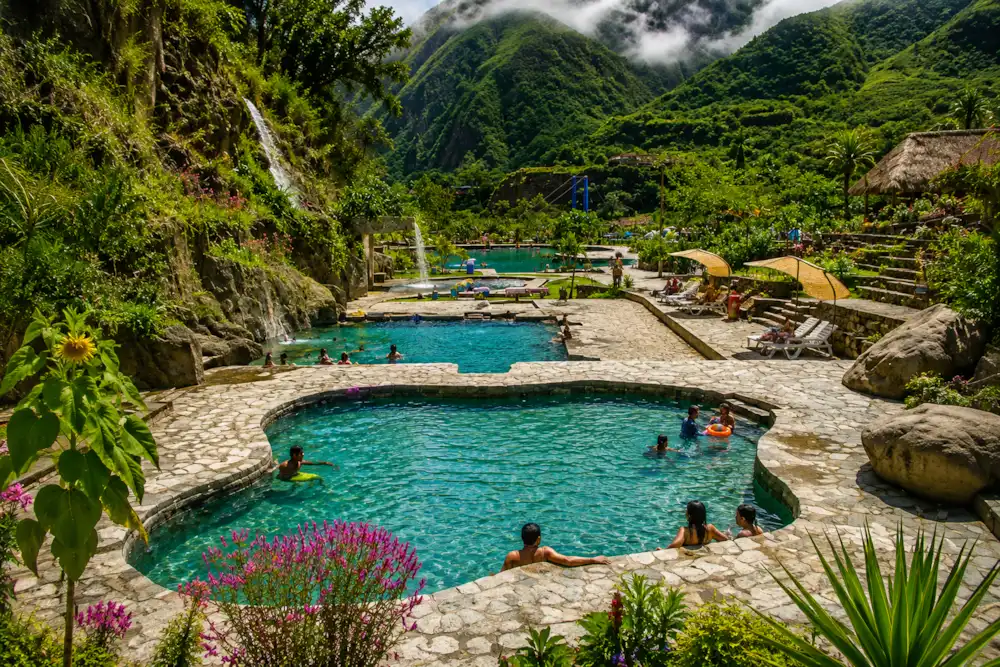
The setting distinguishes the Salkantay hot springs from a conventional spa. Instead of an enclosed wellness center, visitors find open-air pools, mountain slopes, tropical vegetation, and the constant sound of the river. Facilities are practical rather than luxurious, generally including changing areas, showers, and places to buy drinks or snacks.
Warm water can feel deeply relaxing after several days of hiking, but the pools should be understood as a leisure and recovery stop rather than a medical treatment. Although many tourism websites attribute therapeutic properties to the mineral water, travelers should not treat a visit as a substitute for medical care.
Hot Springs Salkantay Trek: Where Cocalmayo Fits Into the Route
Travelers searching for hot springs Salkantay trek are usually trying to determine whether Cocalmayo is included in the standard itinerary. The answer depends on the operator, the number of trekking days, and where the group spends the third night.
On many five-day itineraries, hikers cross the Salkantay Pass on the second day and descend into the cloud forest toward Chaullay or Collpapampa. The following day continues through warmer valleys toward La Playa, Lucmabamba, or Santa Teresa. This is usually the most convenient stage for visiting the Salkantay hot springs.
The current Climb Sunday five-day itinerary reaches Santa Teresa on day three and gives travelers free time to visit Cocalmayo. The entrance fee is listed separately, meaning that the stop is available but admission is not automatically included in the package.
Some operators include transportation and admission. Others present the visit as an optional activity paid locally. Shorter four-day programs may skip Santa Teresa, reduce the time available, or transfer directly toward Hidroelectrica. Climb Sunday’s four-day route, for example, travels from Playa Sahuayaco to Hidroelectrica and Aguas Calientes without an overnight stop in Santa Teresa.
Travelers should therefore never assume that the Salkantay hot springs are automatically part of every package.
Before booking, ask four questions: Is Cocalmayo included? Is the entrance fee included? How long will the group stay? Will transportation between the campsite, Santa Teresa, and the pools be provided? These details determine whether the visit feels restorative or rushed.
Why the Salkantay Hot Springs Feel So Rewarding
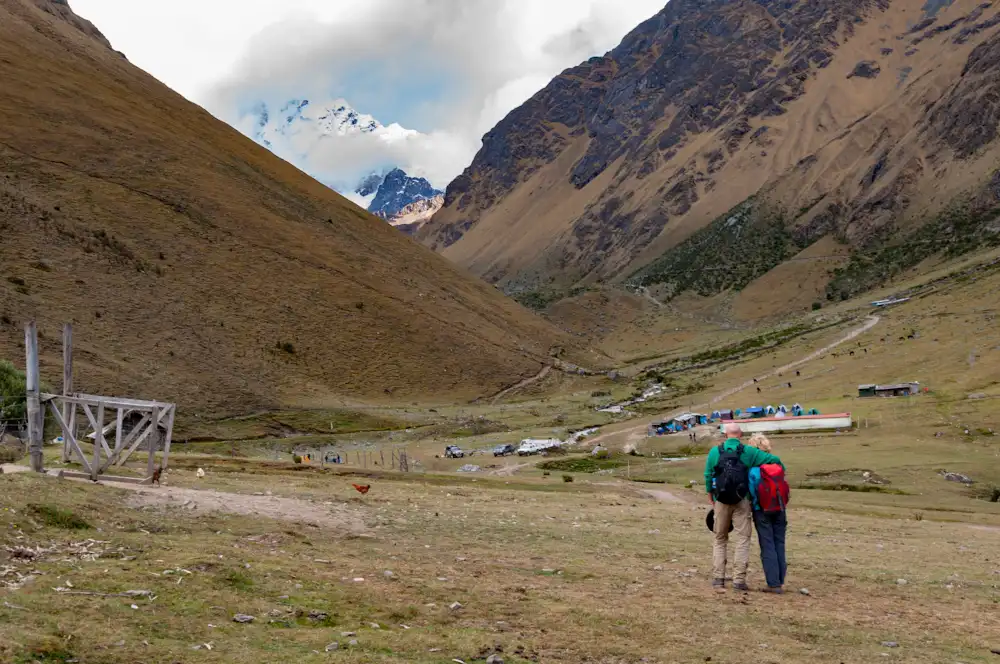
The physical contrast between the high Andes and the valley makes the Salkantay hot springs particularly memorable. At the pass, trekkers may face strong wind, cold temperatures, steep terrain, and an elevation of around 4,600 meters. Later, the route descends more than 3,000 meters into a warmer and greener ecosystem.
This dramatic change is one of the defining features of Salkantay. In only a few days, travelers move from snow-covered mountains and glacial lakes to orchids, fruit trees, waterfalls, and coffee-growing areas. The Salkantay hot springs represent the moment when that transition becomes fully tangible.
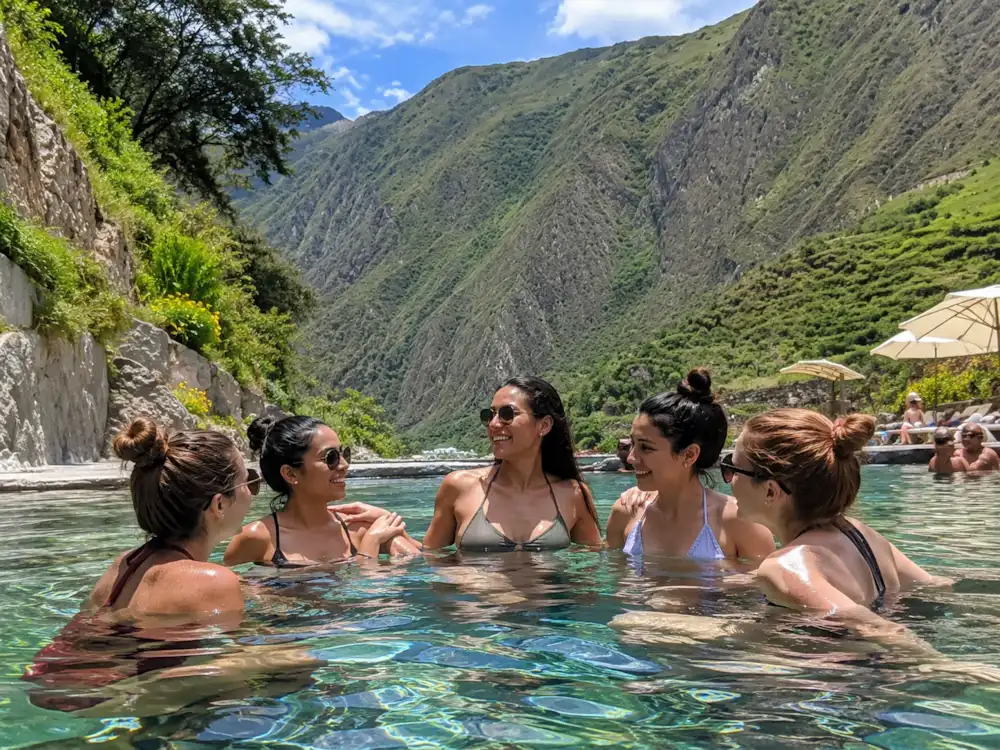
They also create a psychological break. The hardest climb is normally behind you, while Machu Picchu is still ahead. Sitting in the pools gives the group time to slow down, recover, and reflect on the landscapes already crossed.
For many visitors, Cocalmayo is not the most famous attraction on the itinerary, but it becomes one of the most personal memories. It is a quiet reward after the high-altitude challenge and before the excitement of reaching Machu Picchu.
What to Expect at Cocalmayo
The Salkantay hot springs are organized around several pools positioned at different levels near the river. Visitors can move between them and choose the temperature that feels most comfortable. Cold showers are also available, creating a refreshing contrast after time in the warm water.
Do not expect a luxury resort. Cocalmayo is better described as a rustic thermal complex in a remarkable natural setting. The attraction comes from the landscape and atmosphere rather than premium spa services. Changing rooms and basic amenities are available, but travelers should carry their own essentials.
Afternoons are popular because trekking groups often arrive after completing the day’s hike. The area may feel busier from mid-afternoon to early evening, particularly during the dry season. Travelers staying overnight in Santa Teresa may prefer an early morning visit, when the Salkantay hot springs can be quieter.
The pools may remain open after sunset, depending on current operating conditions. Night visits provide a different atmosphere: the valley becomes cooler, the surroundings grow darker, and the sound of the river becomes more noticeable.
Anyone visiting after dark should organize return transportation before entering. Mobile coverage and local transport availability should not be taken for granted late at night.
Current Opening Hours, Fees, and Access
Recent tourism sources commonly report that the Salkantay hot springs open early in the morning and close at approximately 9:00 p.m. or 10:00 p.m. Admission is often listed at around S/10 for foreign visitors and S/5 for Peruvian visitors. These details can change because of maintenance, weather, seasonal operations, or local decisions, so confirm them shortly before visiting.
Cocalmayo is approximately four kilometers from central Santa Teresa. A taxi or mototaxi is the easiest option, while walking may take around one hour depending on pace and route conditions.
Travelers arriving as part of a Salkantay tour are commonly transferred from their campsite or accommodation. Nevertheless, transport arrangements vary, and the return journey should be confirmed before the group enters the pools.
Carry Peruvian soles in cash. Card payment should not be assumed at the entrance, in local transport, or at small businesses near the pools. Cash may also be useful for drinks, snacks, towel rental, or other minor expenses.
Because published rates and schedules are not always updated immediately, travelers should use them as planning estimates rather than guaranteed conditions.
How to Reach the Salkantay Hot Springs Without the Full Trek
You do not need to complete the entire hike to visit the Salkantay hot springs. Independent travelers can reach Santa Teresa by road from Cusco through Santa María, although the journey is long and road conditions can vary.
The usual overland journey involves traveling from Cusco to Santa María and then continuing by colectivo or taxi to Santa Teresa. From the town, visitors take local transport or walk to Cocalmayo.
Another option is to combine the pools with the alternative route to Machu Picchu through Hidroelectrica. From Santa Teresa, travelers continue by local transport to Hidroelectrica and then walk beside the railway line toward Aguas Calientes.
This approach is popular with independent and budget-conscious travelers, but it requires careful coordination of:
- Local transportation and departure times.
- Daylight available for the railway walk.
- Luggage storage or transportation.
- Accommodation in Santa Teresa or Aguas Calientes.
- Machu Picchu tickets and assigned entry times.
The Salkantay hot springs can also be visited after Machu Picchu by traveling from Aguas Calientes toward Hidroelectrica and continuing to Santa Teresa. However, this reverse route may take most of the day and should not be treated as a quick excursion.
For visitors with limited time, an organized itinerary is usually more efficient than building the journey through separate local transfers.
Choosing the Right Salkantay Tour
A strong Salkantay tour should balance challenge, safety, cultural interpretation, and recovery. The cheapest itinerary is not always the best value, especially when it compresses the route, removes scenic sections, or leaves little time at Cocalmayo.
Review the day-by-day plan before booking. Confirm each overnight location, expected walking time, maximum altitude, luggage support, meals, guide experience, emergency procedures, and Machu Picchu arrangements.
A professional guided route should clearly explain:
- Whether horses or muleteers transport the main luggage.
- How much weight each traveler can place in the transported duffel bag.
- Whether oxygen and first-aid equipment are available.
- Which meals and accommodations are included.
- Whether Cocalmayo admission and transportation are included.
- Which Machu Picchu ticket and circuit form part of the package.
If the Salkantay hot springs are important to you, request written confirmation that the visit is included or possible. Some tours advertise Cocalmayo but allocate only a short stop. Others allow enough time for a relaxed visit and include transport both ways.
Climb Sunday offers four- and five-day trekking options, with the five-day itinerary providing free time in Santa Teresa for Cocalmayo. Its guided service includes logistical support, meals, camping equipment, local guides, transportation, and Machu Picchu arrangements, although specific exclusions must be checked before booking.
A well-planned Salkantay tour can connect Humantay Lake, the mountain pass, the cloud forest, the Salkantay hot springs, and Machu Picchu as one coherent journey.
Best Time to Visit Salkantay and Cocalmayo
The dry season, generally from May through September, is the most popular period for Salkantay. Trails are usually drier, mountain views are often clearer, and travel through the high sections can be more predictable. It is also the busiest season, so tours, accommodation, and Machu Picchu tickets should be booked early.
April and October can offer a balance between lower visitor numbers and relatively favorable conditions. Rain remains possible, but many travelers appreciate the greener landscape and quieter trail.
The rainy season normally becomes more intense from December through March. Heavy rain can affect trails, roads, river levels, and access around Santa Teresa. Local tourism information warns that intense rain can occasionally produce roadblocks or landslides in this area.
The Salkantay hot springs may still operate during the wetter months, but travelers should confirm local conditions before departure and maintain flexibility in their schedule.
No matter the month, weather on Salkantay changes quickly. The pass may be cold while Santa Teresa is warm and humid, so packing for multiple climates is essential.
What to Pack for the Salkantay Hot Springs
Place your swimsuit in an accessible section of your daypack rather than inside luggage transported by horse or vehicle. A compact quick-dry towel is practical because it weighs less and dries faster than cotton.
Bring sandals or water-friendly footwear for wet surfaces and a dry change of clothes for after the pools. Insect repellent is useful in the warmer valley, particularly around sunset, while sunscreen remains important during daytime visits. These items are also included in Climb Sunday’s recommendations for its five-day trek.
A reusable water bottle helps you stay hydrated before and after bathing. Keep your phone, passport, cash, and valuables in a waterproof pouch or secure bag.
The essentials are simple:
- Swimwear: Keep it in your daypack so it remains available when your main luggage is being transported separately.
- Quick-dry towel: It takes up less space and is easier to dry during a multi-day trek.
- Sandals: They provide more comfort and grip around the pool area than trekking boots.
- Dry clothing: Changing after bathing prevents you from returning to camp in wet clothes.
- Insect repellent: Santa Teresa has a warmer, more humid environment than the high-altitude stages.
- Water and cash: Hydration is essential, and small local services may not accept cards.
Safety and Responsible Travel Tips
Enter the Salkantay hot springs gradually, especially if you are tired, dehydrated, or sensitive to heat. Do not remain in the hottest pool for an extended period. Take breaks, drink water, and move to a cooler pool if you feel light-headed.
Wet stone and tiled areas can be slippery, so walk carefully. Follow staff instructions and respect any area that is temporarily closed.
Avoid using soaps, shampoos, or other products inside the thermal pools. Take all waste with you and limit single-use plastic whenever possible.
Respect other visitors by keeping noise under control, particularly during early morning or evening visits. Do not block the pools for extended photography sessions, and ask permission before photographing local visitors at close range.
The Salkantay hot springs are part of a local tourism economy. Buying food, drinks, transport, or services from responsible local businesses helps the Santa Teresa community benefit from your visit.
Cocalmayo or the Hot Springs in Aguas Calientes?
Travelers sometimes confuse the Salkantay hot springs with the thermal baths in Aguas Calientes. They are separate attractions with different settings and travel experiences.
Cocalmayo is near Santa Teresa and is surrounded by a more open natural landscape. It fits naturally into selected Salkantay and Inca Jungle itineraries. The pools in Aguas Calientes are within Machu Picchu Pueblo and are easier to reach for visitors arriving by train.
Aguas Calientes is more convenient, but Cocalmayo usually feels more connected to the outdoor journey. The Salkantay hot springs arrive after trekkers have completed the most demanding mountain stages and are approaching Machu Picchu.
Travelers with enough time can visit both, but they should not expect identical experiences. Cocalmayo is generally chosen for scenery and route integration, while Aguas Calientes is chosen for convenience.
Frequently Asked Questions About Salkantay Hot Springs
Are the Salkantay hot springs included in every trek?
No. Cocalmayo is included in some itineraries and offered as an optional activity in others. Confirm the schedule, transportation, admission fee, and visit duration before booking.
Where are the Salkantay hot springs located?
They are near Santa Teresa in La Convención Province, Cusco, approximately four kilometers from the town center and close to the Urubamba River.
How hot is the water at Cocalmayo?
The source water is commonly reported between approximately 38°C and 44°C. Individual pools may feel cooler depending on water flow, pool size, weather, and operating conditions.
What day of the trek includes Cocalmayo?
Many five-day programs visit on day three, after the descent into the cloud forest. Shorter itineraries may omit the stop or place it at a different stage. Climb Sunday’s current five-day route provides free time for Cocalmayo on day three.
How much is the entrance fee?
Recent sources commonly list admission at approximately S/10 for foreign visitors and S/5 for Peruvian visitors. Prices can change, so confirm the rate shortly before traveling.
Is Cocalmayo better than the hot springs in Aguas Calientes?
Neither is objectively better. Cocalmayo offers a more natural atmosphere and stronger integration with the trekking route, while Aguas Calientes is easier to access.
Final Thoughts
The Salkantay hot springs are more than a pleasant optional extra. They mark the transition from the demanding high-altitude section of the route to the warmer final approach toward Machu Picchu.
When properly integrated into the itinerary, the pools provide time to recover, appreciate the changing landscape, and enjoy Santa Teresa without turning the day into a race. The key is choosing a Salkantay tour that clearly explains what is included and allows enough time at Cocalmayo.
That combination is why the Salkantay hot springs deserve a planned place in the itinerary. For travelers who want adventure without losing the value of rest, the Salkantay hot springs can become one of the most satisfying moments of the journey.
Plan the stop carefully, pack the right essentials, and let the warm water close one chapter of the trek before Machu Picchu begins the next.
