
Beyond the Granite Walls of Machu Picchu
When travelers plan their journey to the Peruvian Andes, the image of Machu Picchu often eclipses everything else. However, for those seeking a deeper understanding of how the Inca Empire managed to sustain a population of millions in such a rugged landscape, the twin sites of Maras Moray are essential.
Located on a high plateau above the Urubamba Valley, these sites represent the pinnacle of Incan ingenuity one a geological miracle and the other a sophisticated scientific laboratory. At Climb Sunday, we invite you and beyond to look closer at these wonders. This guide provides a comprehensive deep dive into the history, science, and logistical secrets of visiting Maras Moray, ensuring your experience is as enriching as it is breathtaking.
You might also be interested in: The Essential Guide to Coca Leaf: Benefits and Altitude Sickness Prevention in Peru
What is Maras Moray? A Tale of Two Wonders
Defining the Contrast Between Salt and Soil in the High Andes
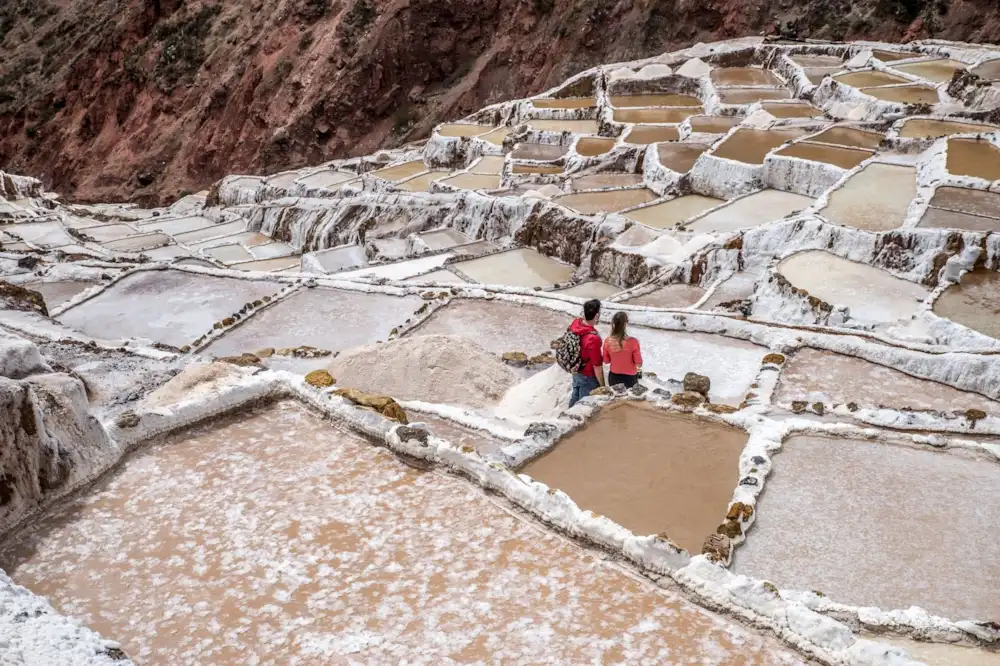
The term Maras Moray refers to two distinct but geographically close archaeological and natural sites: the Salineras de Maras (Salt Mines) and the archaeological site of Moray. While they are often grouped together in a single day trip, they serve entirely different historical and functional purposes. Maras is a collection of over 3,000 small salt evaporation ponds that have been in use since pre-Inca times, whereas Moray consists of massive, circular terraced depressions that served as a botanical research station for the Incas.
Visiting Maras Moray is like walking through a living museum of Andean technology. On one hand, you have the shimmering white and ocher palette of the salt pans, and on the other, the deep, concentric greens of the experimental terraces. Together, they offer a narrative of how the Andean people mastered their environment, harnessing both the minerals of the earth and the microclimates of the mountains to build one of history’s most successful civilizations.
The History of Moray: An Inca Agricultural Laboratory
Unlocking the Secrets of the Concentric Terraces and Microclimates
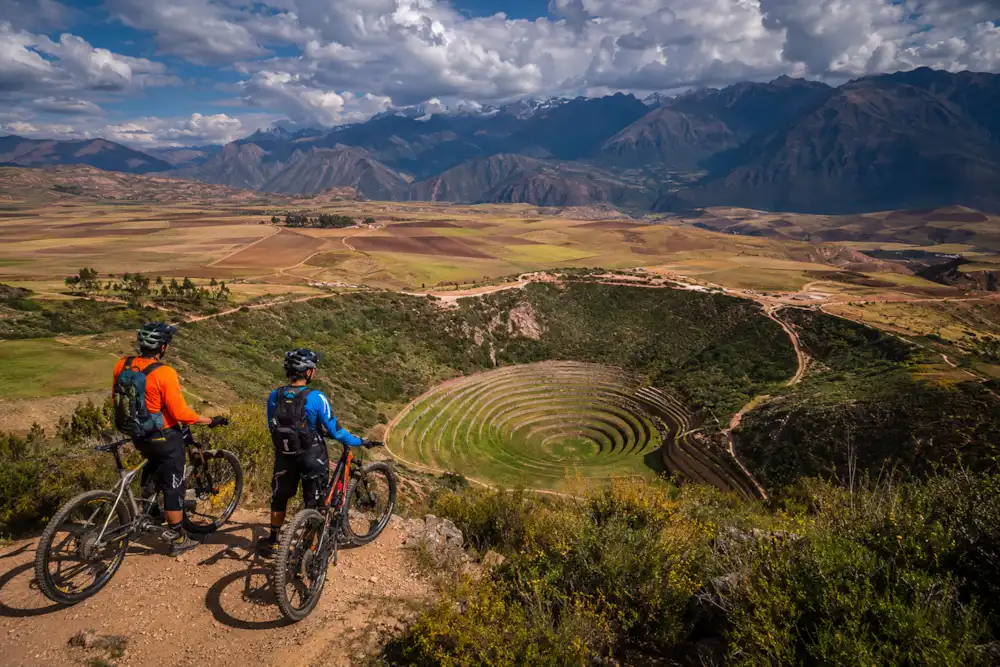
The archaeological site of Moray is perhaps the most visually striking ruin in the Sacred Valley. From above, it looks like a giant green amphitheater or even a landing pad for ancient deities. However, the reality is much more practical and scientifically impressive. Historians and archaeologists believe that Moray was an agricultural research station. The depth of the terraces the largest is about 30 meters (98 feet) deep creates a temperature difference of up to 15 degrees Celsius (27 degrees Fahrenheit) between the top and the bottom.
This incredible temperature gradient allowed the Incas to simulate different ecological zones from across their vast empire. They could test how different varieties of corn, potatoes, and quinoa grew in the climates of the jungle, the coast, or the high puna, all within a single location. By the time you finish walking through Maras Moray, you will understand that the Incas were not just master stonemasons; they were master geneticists and botanists. Each terrace level likely represented a different altitude, allowing for the domestication of hundreds of crop variations that fed the Incan expansion.
The Salt Mines of Maras: Ancient Tradition Meets Natural Phenomenon
Witnessing the Millennial Extraction of ‘White Gold’ in the Andes
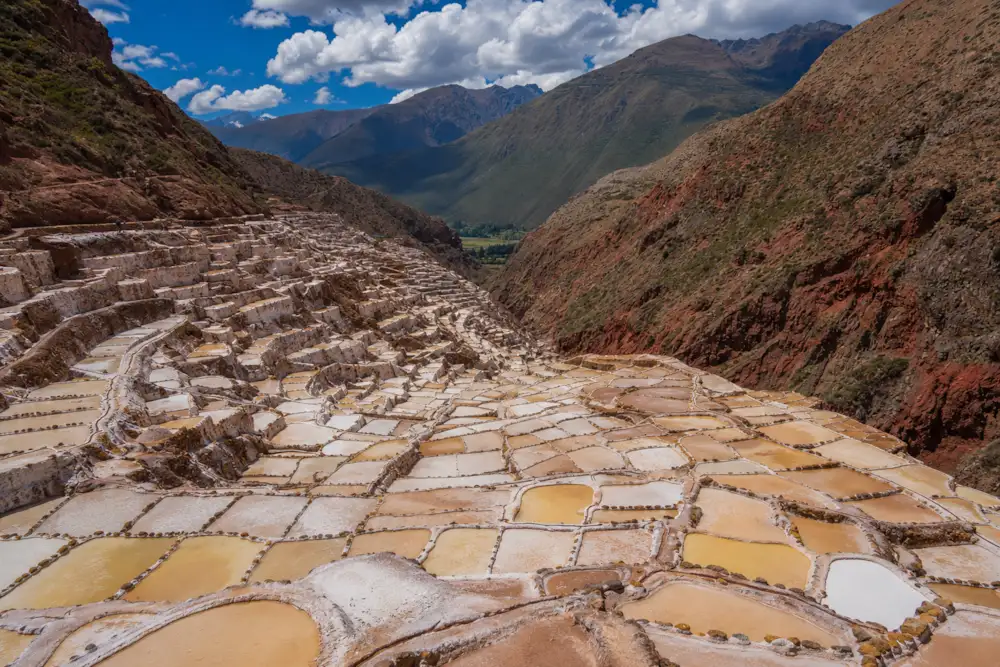
Just a short drive from the terraces lies the Salineras de Maras. This site is a geological anomaly where a hypersaline spring, known as Qoripujio, emerges from the mountain. For over a thousand years, the local communities have diverted this water into thousands of shallow, hand-carved ponds. As the water evaporates under the intense Andean sun, the salt crystallizes, leaving behind the famous “Maras Salt,” which is prized by gourmet chefs worldwide for its mineral complexity and pinkish hue.
What makes the salt pans of Maras Moray truly special is the social structure behind them. The mines are still operated by the local families of the Maras community under a communal system that dates back centuries. Each family is assigned a specific number of ponds, and the work of maintaining the pans and harvesting the salt is a labor of love passed down through generations. When you visit these pans, you aren’t just looking at a postcard; you are witnessing an active industry that has survived empires, colonial rule, and the modern era.
Where is Maras Moray Located? Mapping the Highland Plateau
Navigating the Geography of the Maras Plateau Above the Sacred Valley
The Maras Moray sites are situated on a high-altitude plateau, approximately 3,500 meters (11,500 feet) above sea level. This plateau sits nestled between the towns of Chinchero, Urubamba, and Calca. The geography here is distinct from the steep, narrow valleys found elsewhere; it is characterized by rolling hills, expansive fields of golden wheat and purple quinoa, and a stunning 360-degree view of the snow-capped Vilcabamba and Urubamba mountain ranges.
Because of its elevated position, the drive to Maras Moray offers some of the most panoramic views in the Cusco region. From certain vantage points, you can see the peaks of Salkantay and Veronica towering in the distance. For guests staying with us in Calca, the journey to the plateau is relatively short, making it an ideal day trip that avoids the long, exhausting bus rides associated with departing from the center of Cusco. This proximity allows for a more relaxed pace, which is essential for fully absorbing the energy of these sites.
What to Do at Maras Moray: Beyond the Standard Guided Tour
Adventure, Photography, and Immersive Cultural Experiences
Most travelers simply walk through the viewpoints of Maras Moray, but there is much more to do for those with an adventurous spirit. At Climb Sunday, we encourage our guests to engage with the landscape in more dynamic ways:
- Mountain Biking: The Maras plateau is one of the world’s premier destinations for cross-country mountain biking. The trails are relatively flat but offer exhilarating descents down into the Sacred Valley, passing directly through the salt pans.
- Photography Workshops: The play of light and shadow on the concentric circles of Moray and the crystalline reflections of Maras are a photographer’s dream. We recommend visiting during the “Golden Hour” (late afternoon) when the salt turns a soft pink and the shadows emphasize the depth of the terraces.
- Community Engagement: In the town of Maras, you can visit local cooperatives to learn about the different types of salt medicinal, culinary, and decorative. Purchasing salt directly from these families is the best way to ensure your visit supports the local economy.
- Trekking: There is a beautiful, little-known trail that leads from the salt pans down to the village of Pichingoto in the valley below. It is a gentle downhill walk that offers a perspective of the mines that 90% of tourists never see.
Best Time to Visit Maras Moray: Weather Patterns and Visual Impact
Choosing Between the Shimmering White Dry Season and the Lush Green Rainy Season
Timing your visit to Maras Moray can significantly change what you see. The Andean seasons dictate the color palette of the landscape:
- Dry Season (May to October): This is the peak time for visiting the salt mines. Since the salt is produced through evaporation, the ponds are at their whitest and most crystalline during these months. The skies are a deep, clear blue, providing a sharp contrast with the ocher earth. However, the terraces of Moray may appear more brown or golden as the grass dries out.
- Rainy Season (November to April): During the rains, the terraces of Moray turn an impossibly vibrant emerald green, looking exactly as they might have during the Inca era. The salt mines, however, can take on a more brownish hue as rainwater mixes with the minerals and slows the evaporation process.
For the “perfect” experience, we often recommend the transition months of April and May. You get the lush greenery at Moray and the beginning of the salt harvest at Maras, offering the best of both worlds.
Logistics: How to Get to Maras Moray and Entrance Fees
Practical Information for a Seamless Sacred Valley Expedition
Reaching Maras Moray requires some planning, as there is no direct public transport to the sites themselves. Most travelers opt for a private tour, which is what we recommend at Climb Sunday to ensure you aren’t rushed through the experience.
- The Boleto Turístico: To enter Moray, you will need the Boleto Turístico del Cusco (Cusco Tourist Ticket). You can buy a partial ticket specifically for the Sacred Valley sites if you aren’t planning to visit everything.
- Maras Entrance Fee: Interestingly, the Salt Mines are not part of the government-run tourist ticket. Because they are managed by the local community, there is a separate entrance fee of approximately 10 to 15 soles. This money goes directly to the families of Maras.
- Transportation: While some people take a colectivo to the “Maras Cross” on the main highway and then a taxi, a private vehicle is much more efficient. If you are staying in Calca, we can arrange a private driver who knows the scenic backroads that avoid the main tourist traffic.
Sustainability and Responsible Tourism at the Salt Mines
Protecting the Integrity of the Site for Future Generations
In recent years, the management of the salt mines at Maras Moray has changed to protect the purity of the salt and the safety of the site. Previously, tourists were allowed to walk among the ponds, but this is no longer permitted. There is now a dedicated wooden boardwalk and several viewpoints that provide spectacular views without contaminating the salt or damaging the fragile pond walls.
At Climb Sunday, we fully support these measures, we know our clients value sustainability. We encourage all visitors to stay on the designated paths and to avoid taking “souvenir” salt directly from the pans. Instead, support the community by buying packaged salt at the exit. By practicing responsible tourism, we ensure that the families of Maras can continue their ancestral traditions for another thousand years.
Comparing Maras Moray to Other Sacred Valley Sites
Why This Destination is a Vital Component of Your Peru Itinerary
Many travelers ask if they should choose between Maras Moray and other sites like Ollantaytambo or Pisac. Our professional advice is that you cannot compare them; they represent different facets of the Inca genius. While Ollantaytambo is a fortress and Pisac is a royal estate/cemetery, Moray is a laboratory and Maras is an industrial site.
If your interest lies in science, engineering, or photography, Maras Moray should be your top priority. The sites offer a more “intellectual” look at the Inca Empire. Furthermore, because these sites are located on the plateau rather than in the valley floor, the light and the sense of space are entirely different. The openness of the Maras plateau provides a sense of peace that is often missing from the more crowded, vertical ruins of the valley.
Conclusion: The Genius of the Earth and the Hand
Final Thoughts on the Magic of Maras Moray
A visit to Maras Moray is a journey into the mind of the Inca. It is a place where nature’s raw power the salt of the earth and the climate of the mountains meets the sophisticated intervention of human hands. For our guests these sites offer some of the most profound memories of their Peruvian adventure. They remind us that the greatness of a civilization is measured not just by its monuments, but by its ability to innovate and sustain itself in harmony with the world.
Are you ready to witness the white gold of Maras and the green circles of Moray? Join us at Climb Sunday for an expedition that goes beyond the surface. Let us show you the engineering marvels that made the Inca Empire the greatest power in the Southern Hemisphere. The plateau is waiting, the salt is shimmering, and the history is yours to discover.
